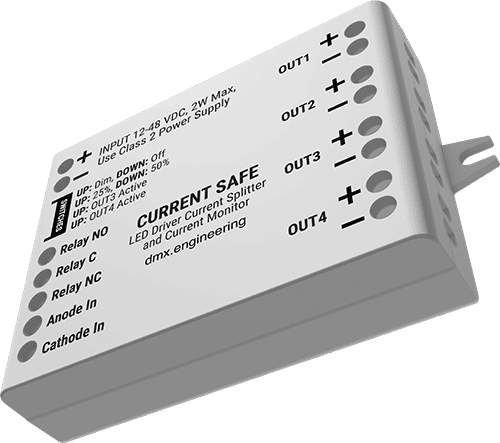
Current Safe
Single Current Input 2-4 Output Current Share/Monitor
Current Safe is a compact, 3.55” x 2.22” x 0.75” tall, self-contained solution for distrib-uting a single constant current input—typically from an LED driver—across multiple out-put channels with active current monitoring and fault response. Designed for simplicity and reliability, it supports 2 to 4 output channels, each monitored for equal current shar-ing. Faults such as open or short circuits trigger a programmable system response and relay signaling.
Key Features
- Equal Current Distribution: Splits one constant current input evenly across 2–4 out-puts, requires that all LED fixtures draw the same current/power
- Active Monitoring: Detects imbalance across outputs and triggers fault response
- Configurable Behavior: DIP switch selects number of outputs and fault response mode
- Relay Output: Dry contact relay toggles on fault (NO and NC supported)
- Fallback Modes: Selectable response: Output shutdown, Dim to 25%, Dim to 50%
- No External Programming: DIP switch interface only—no host controller required
- Floating Current Path: Input/output current lines are isolated from DC supply ground
Installation Overview
- Connect constant current source to Anode In and Cathode In, up to 60VDC @ 5A
- Wire up to four LED fixtures to OUT1–OUT4
- Set DIP switches to match fixture count and desired fault behavior
- Optionally connect relay output to external fault signaling system
DC POWER INPUT
Voltage range: 12-48 VDC, Class 2
CURRENT INPUT FROM LED DRIVER
2-wire floating Anode and Cathode
Max 60VDC, Up to 10A of input current max.
OUTPUTS – 2 TO 4 (SELECTABLE)
All output loads (fixtures) must be the same current load Input current is split to active outputs, and monitored
CONNECTORS
Wire range, solid & stranded: 0.5 – 1.5 mm2
14 – 22 AWG, rated to 15A
Wire strip length: .25” (6 – 7 mm)
Tightening force: 0.4 Nm / 2.6 Lb-in
OPERATING CONDITIONS
Ambient temperature, ta: -13…+113°F (-25…+45°C)
Max. case temperature, tc: +167°F (+75°C)
Storage temperature: -13…+167°F (-25…+75°C)
Max. relative humidity: 0…80%, non-cond.

INSTALLATION DETAILS
THEORY OF OPERATION
Current Safe is a pass-through LED driver interface that accepts the driver’s output and distributes the same voltage and current across up to four output channels (OUT1–OUT4). Internal measurement components monitor current flow but do not alter output levels.
Load Distribution Rules: If two fixtures are connected to OUT1 and OUT2, input current is split equally: 50% to each. If three fixtures are connected to OUT1–OUT3, input current is divided into thirds. If four fixtures are connected to OUT1–OUT4, input current is divided into fourths.
Fault Detection and Response: Current Safe continuously samples input current and compares it to each active output channel. If a channel shorts or goes open, the system detects imbalance and responds based on DIP1 and DIP2 settings.
DIP Switch Behavior:
DIP1 (Fault Response Mode): Down: Relay toggles to alert state only. Use relay to disable the LED driver and protect fixtures. Up: Enables current reduction based on DIP2.
DIP2 (Current Reduction Level): Down: Reduces input current to 25% of original. Up: Reduces input current to 50% of original.
INSTALLATION
Power Input Connect a Class 2 power supply (12–48 VDC) to the Current Safe input connector.
Driver Output Connection Connect the LED driver output to Anode In (+) and Cathode In (–), observing correct polarity. 10A maximum!
Relay Output (Optional Monitoring)
Use relay output for fault monitoring via dry contact closure.
C = Common, NO = Normally Open (closes on fault).
Multiple units can be paralleled via relay output.
Fixture Connections
Connect 2–4 LED fixtures to OUT1–OUT4.
Observe polarity: Anode = (+), Cathode = (–).=
Single fixture use is not recommended.
DIP Switch Configuration
DIP3: Set Up if OUT3 is used, Down if not.
DIP4: Set Up if OUT4 is used, Down if not.
Power-Up Sequence
Power on the Current Safesupply.
Power on the LED driver and verify fixture operation
TYPICAL CONNECTION DIAGRAM
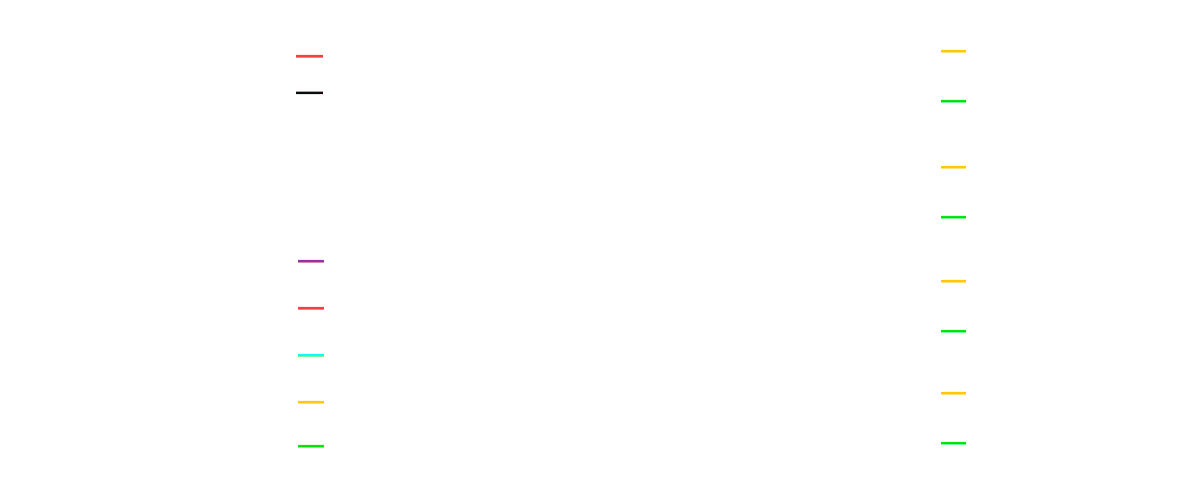
* The relay must be protected against inductive over voltage spikes, i.e. it must have a flyback diode. Do not connect a typical PCB relay without the diode.
Dimensions are in mm. 90.0 x 56.4 x 19.0 mm Weight: 2.0 oz (56 g)
COMPLIANCE STATEMENT
This device complies with part 15 of the FCC Rules. Operation is subject to the following two conditions:
(1) This device may not cause harmful interference, and
(2) This device must accept any interference received, including interference that may cause undesired operation.
Warning
Changes or modifications not expressly approved by DMX Engineering and Design LLC could void the user’s authority to operate the equipment.
FCC Interference Statement
This equipment has been tested and found to comply with the limits for a Class B digital device, pursuant to Part 15 of the FCC Rules. These limits are designed to provide reasonable protection against harmful interference in a residential installation. This equipment generates, uses and can radiate radio frequency energy and, if not installed and used in accordance with the instructions, may cause harmful interference to radio communications. However, there is no guarantee that interference will not occur in a particular installation. If this equipment does cause harmful interference to radio or television reception, which can be determined by turning the equipment off and on, the user is encouraged to try to correct the interference by one of the following measures:
Reorient or relocate the receiving antenna.
Increase the separation between the equipment and receiver.
Connect the equipment into an outlet on a circuit different from that to which the receiver is connected.
Consult the dealer or an experienced radio/TV technician for help.
Radiation Exposure Statement for Canada
This device complies with Industry Canada’s license-exempt RSSs. Operation is subject to the following two conditions:
(1) This device may not cause interference
(2) This device must accept any interference, including interference that may cause undesired operation of the device. This equipment is exempt from the routine RF exposure evaluation requirements of RSS-102. This equipment should be installed and operated with a minimum distance of 20 cm between the antenna and the user or bystanders.
Le présent appareil est conforme aux CNR d’Industrie Canada applicables aux appareils radio exempts de licence. L’exploitation est autorisée aux deux conditions sui-vantes:
(1) l’appareil ne doit pas produire de brouillage;
(2) l’utilisateur de l’appareil doit accepter tout brouillage radioélectrique subi, même si le brouillage est susceptible d’en compromettre le fonctionnement. Ce matériel n’est pas sujet à l’évaluation habituelle d’exposition RF selon RSS102. Ce matériel devrait être installé et exploité en gardant une distance minimale de 20