
DMX Channel S changes. Zhaga DMXcas publishes the new value to Gateway Channel 1.
OUTDOOR DMX-512 → CASAMBI · Z10 KEY A
Zhaga DMXcas
Bring the outdoor DMX control bus into Casambi.
Zhaga DMXcas packages the proven eight-channel DMXcas gateway in a sealed, field-replaceable 40 mm outdoor interface. Receive one adjacent DMX block and map its eight Gateway channels to fixtures, groups, scenes or project logic.
 MADE IN USADesigned, built and supported in Mesa, Arizona
DMX CONTROLLER → Zhaga DMXcas → CASAMBI GATEWAY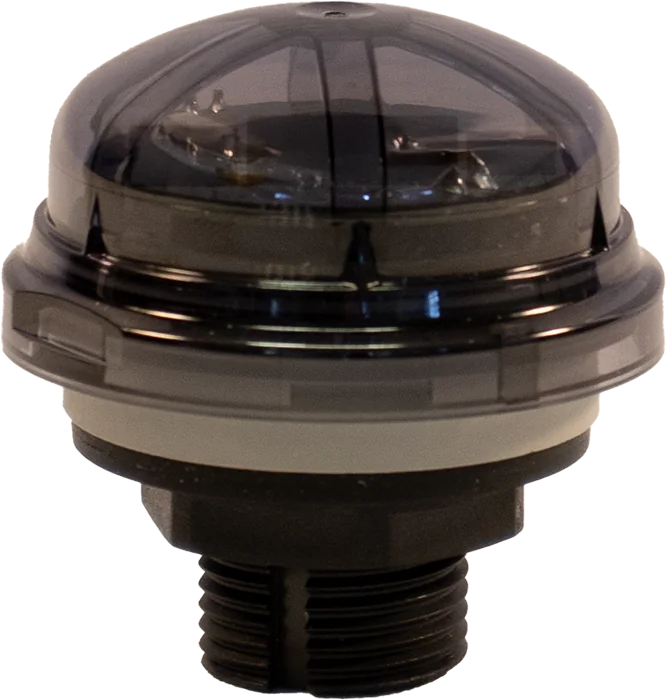
DMX INCASAMBI
Receive eight adjacent DMX values at the luminaire and publish them into the Casambi network.
8 channelsfixed adjacent DMX input block
1–505valid start-address range
IP66non-submersible when correctly installed
THE BRIDGE GOES THIS DIRECTION
DMX in.
Casambi out.
Zhaga DMXcas is the other side of casDMX. It listens to a conventional DMX controller and publishes changed levels into Casambi; it does not generate a DMX universe.
DMX consoleArchitectural controller, show console or building control
source
→
Zhaga DMXcasEight-channel receiver + Casambi Gateway
→
Casambi networkMapped fixtures, groups, scenes and control logic
40 MM OUTDOOR INTERFACE
The DMX input lands at the socket.
A compatible TE LUMAWISE Endurance S Z10 Key A receptacle carries Class 2 power and the complete three-wire DMX input. The radio stays above the luminaire instead of behind metalwork.
KEY A
1+12–24 VDC
20 V / DMX common
3DMX+
4DMX−
DO NOT ASSUME BOOK 18 / D4i
Order by the Z10 Key A part number.
This interface carries DMX, not a DALI/D4i bus. Do not select a receptacle by diameter alone, substitute a Book 18 component or defeat the mating key.
- Pin 1 — +12 to +24 VDC from a Class 2 constant-voltage supply
- Pin 2 — DC return and continuous DMX common/reference
- Pin 3 — DMX data positive from the master
- Pin 4 — DMX data negative from the master
Recommended TE receptacles: 2343403-1, 2363638-2 or 1-2363638-2. Verify the current socket documentation and seal stack.
INTERACTIVE EIGHT-CHANNEL MAP
Set S once.
Receive S through S+7.
The channel count is always eight and the addresses are always consecutive. Zhaga DMXcas cannot skip a slot or pick eight unrelated addresses.
Choose the first address
Valid range is 1–505 so the complete eight-channel block stays inside one 512-channel universe.
ONLY CHANGES ARE PUBLISHED
Moving a DMX value creates a new Gateway update. An unchanged DMX level does not continuously overwrite a newer app or switch action.
Moving a DMX value creates a new Gateway update. An unchanged DMX level does not continuously overwrite a newer app or switch action.
DMX INPUT BLOCK201–208
CASAMBI PAYLOADGateway 1–8
INTERACTIVE TRANSMIT-DELAY STAGGER
Spread eight updates across a busy network.
Leave delays at zero when the network is reliable. When a simultaneous eight-channel move overloads a large network, increase the step gradually and prove it under real traffic.
Build a stagger
Each channel waits until its DMX value remains unchanged for its delay interval.
DO NOT GUESS
Delay is intentional latency. Large settings make rapid moves and fades feel slow because each new DMX change restarts that channel’s timer.
Delay is intentional latency. Large settings make rapid moves and fades feel slow because each new DMX change restarts that channel’s timer.
EXAMPLE RELEASE WINDOW0–700 ms
CHANNELS8 independent
ONE FIXED PROFILE · NINE VENDOR PARAMETERS
One address chooses the block. Eight delays tune traffic.
Every Gateway channel has its own stabilization delay, from immediate publishing through 2500 ms.
IDPARAMETERRANGEFIELD EFFECT
0DMX Start Address1–505Selects the first address of the fixed S…S+7 block.
1Channel 1 Transmit Delay0–2500 msStabilization interval before Gateway Channel 1
publishes.
2–8Channels 2–8 Transmit Delay0–2500 ms eachIndependent matching intervals for the remaining seven
channels.
WIRE THE RECEPTACLE ONCE
Receive DMX above the luminaire.
Keep the DMX pair and common continuous through the outdoor equipment. The socket makes the Casambi gateway replaceable while the installed cable and luminaire wiring remain in place.
PINS 1 + 2 · CLASS 2 POWER
Apply +12–24 VDC to pin 1 and return to pin 2. Use a constant-voltage supply; never a constant-current LED output.
PINS 3 + 4 · DMX INPUT
Pin 3 is DMX+ and pin 4 is DMX− from the DMX master. Pin 2 supplies the required common/reference for the non-isolated bus.
Preserve the bus: use DMX-rated twisted pair, carry DMX+, DMX− and common continuously, and avoid passive branches. If this is the last receiver and the bus is unstable, terminate with 120 Ω across DMX+ and DMX− at the far end.
MAP · STAGGER · PROVE
Commission the complete signal path.
Record the eight-address block, Gateway mapping, all eight delays, termination status and loss-of-DMX behavior.
PDFInstallation manualRatings, Z10 socket pinout and field wiring.PDFDMXcas controls referenceMapping, delays, shared control and functional tests.
Need to bring a console into Casambi?
Bring us the DMX schedule and the intended Gateway targets.
Bring us the problem ↗