Have an unusual DMX personality?
Bring us its channel chart and intended Casambi controls.
Bring us the problem ↗
OUTDOOR CASAMBI → DMX-512 · Z10 KEY A
Zhaga casDMX brings the proven casDMX engine outdoors in a sealed, field-replaceable 40 mm interface. Select the fixture profile, set one DMX start address, and drive up to 12 adjacent channels from the Casambi app, scenes, switches and schedules.
 MADE IN USADesigned, built and supported in Mesa, Arizona
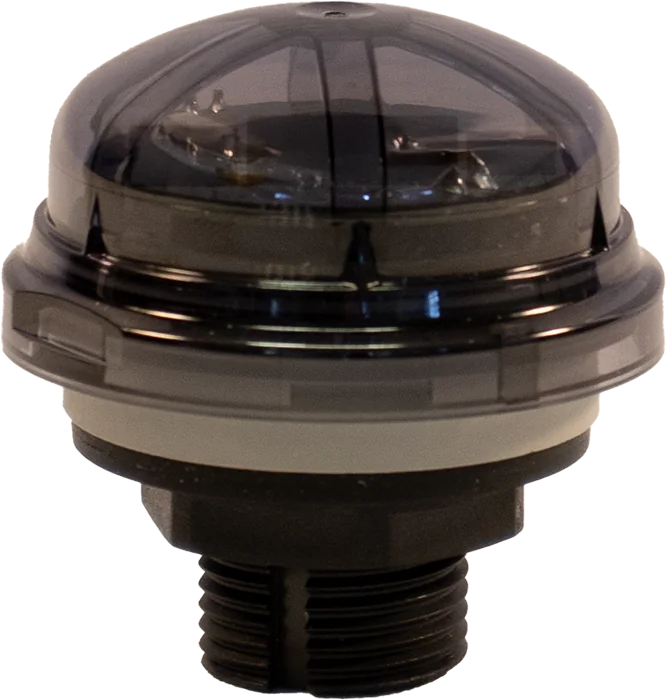
Outdoor-ready at the luminaire, with the same strict adjacent DMX addressing as casDMX.
THE BRIDGE GOES THIS DIRECTION
The app, scenes, switches and schedules control Casambi Elements. Zhaga casDMX turns those values into the adjacent DMX slots expected by the selected fixture personality.
40 MM OUTDOOR INTERFACE
Mount the controller in a compatible TE LUMAWISE Endurance S Z10 Key A receptacle. The keyed, replaceable interface carries Class 2 power, DMX data and the shared DMX reference.
The enclosure is a 40 mm Z10 Key A format using DMX Engineering's proprietary DMX assignment. Do not use a Zhaga Book 18 receptacle, DALI/D4i interface, adapter or modified key.
Compatible TE receptacles: 2343403-1, 2363638-2 or 1-2363638-2. Verify current TE documentation before release.
INTERACTIVE PROFILE + ADDRESS LAB
Zhaga casDMX accepts one start address. Every profile channel occupies the next DMX slot—S, S+1, S+2 and onward—with no gaps.
This demonstration illustrates the released mapping. It does not configure hardware.
MATCH FUNCTION AND CHANNEL ORDER
Choose by fixture function and DMX channel order—not just channel count. Evolution and NoMix profiles can behave differently.
REPEAT A DRIVER CHANNEL BLOCK
For cascaded linear drivers that consume and remove their own slots, Copy Channel Count repeats the first N controlled values across the outgoing frame.
THREE VENDOR PARAMETERS
Normally leave the 512-channel frame and copying disabled. Change them only when the fixture or driver architecture requires it.
WIRE THE RECEPTACLE ONCE
Wire a compatible Z10 Key A socket inside the luminaire, then keep the controller and its radio above the metalwork. The keyed top-mounted module can be replaced without disturbing the field bus.
Apply +12–24 VDC to pin 1 and return to pin 2. Use a constant-voltage supply; never connect a constant-current LED output.
Pin 3 is DMX+ and pin 4 is DMX−. Pin 2 is also the mandatory DMX common because this DMX output is non-isolated.
One continuous bus: use DMX-rated twisted pair, avoid passive T or star branches, and use an active splitter where a branch is unavoidable. Terminate across DMX+ and DMX− at the final receiver only—never at Zhaga casDMX.
DESIGN · ADDRESS · PROVE
Record the selected profile, start address, exact controlled range, frame length and termination status.
Bring us its channel chart and intended Casambi controls.
Bring us the problem ↗